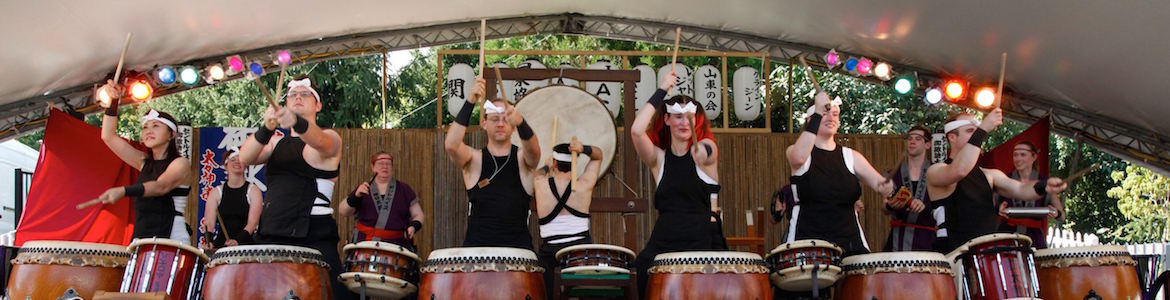
The Music of St. Louis Osuwa Taiko
Our repertoire is a mix of traditional pieces written by our group's founder, Grandmaster Daihachi Oguchi, such as Hiryu San-dan Gaeshi. We also play our own original pieces, including Tenchi, which means "heaven and earth," and Tsurugi no Mai, which depicts a sword dance.
Ashura
Mas Kodani of Kinnara TaikoThe word Ashura is derived from the Sanskrit word asura, which means "God of the Flame." Ashura liked fighting, anger and a battle, and lived in the bottom of the sea and under the ground. It had three faces, six arms and a black-and- blue or red body. After Ashura was taken into Buddhism, it was added to the eight kinds of God who keep the teachings of Buddha, and it became the guardian deity of Buddhism. In Japan, it the mythology has been around since the Tenpyo period (710-784).
Drive
Michele TangThe fast rhythm and repeated pointing motions signify the drive to stay ahead and achieve.
Listen
Hachijou
OndekozaSt. Louis Osuwa Taiko's version of Hachijo was adapted from a piece called "Utsu-Hachijo," which was composed by Ondekoza, sometimes called "the demon drummers of Japan." St. Louis Osuwa Taiko plays a modified version, playing in a very low drumming style which requires great power, concentration, and flexibility.
Hanabi
Hiroshi Tanaka of Standford TaikoHanabi means "fireworks," and you can feel and see the fireworks bursting overhead in the festive rhythm and sweeping motions.
Hayate
Ryuichi Yoshinari of VolkreisMeaning "strong wind" or "swift wind." Hayate was composed by former Oedo Sukeroku Taiko member Ryuichi Yoshinari, a professional soloist and leader of team Volkreis in Toyama, Japan. Hayate's sweeping motions and fast fuchi (rim) hits are its defining features.
Hiryu San-dan Gaeshi
Daihachi Oguchi of Osuwa TaikoHiryuu San-dan Gaeshi means "dragon gods descending to Earth three times." The main body is played three times; each repetition calls upon the dragon gods to come to earth to bless mankind with peace, prosperity and good fortune.
Ibuki
Written by Andrew Thalheimer, Coreography by Julie WieseIbuki (息吹), meaning "breath," or "vitality," was written for St. Louis Osuwa Daiko's 2013 collaboration with the African Dance group "Afriky Lolo." The intention is to blend the terpsichorean vitality of African drum rhythms with the power and modern tradition of taiko. Thanks to Diádié Bathily for the opportunity to write this piece and perform with Afriky Lolo.
JuugoYa
Andrew ThalheimerThe JuugoYa is the harvest festival of the "fifteenth moon." This piece was named after the festival because it has the number "fifteen" in it. In reality, this piece was written to blend some different styles of music and dance with taiko, from European folk music to tango. Any relation to harvests is purely coincidental.
Kagura
Daihachi Oguchi of Osuwa TaikoThis is a piece about the mythical origin of wadaiko. The goddess of the sun, Amaterasu, was upset because her brother ran his oxen over her fields, destroying them. Pouting, she holed herself up in a cave, plunging the world into darkness. Ame no Uzume danced on an overturned sake barrel, making the first sounds of taiko. The gods had such a good time, Amaterasu could not resist and came out.
Kaifuu
Andrew ThalheimerKaifuu means "ocean wind." As the piece progresses, Kaifuu itself represents ocean waves in various states of calm and excitement, stirred by the wind. This is conveyed by the strong but steady rhythm and wave-like motions.
Listen
Kokoro no Koe
Jaclynn LettKokoro no Koe means "voice of the heart." This piece is about reflecting upon the accomplishments, disappointments and aspirations in our lives. Although this is a calm and quiet process, there is also the pressure of time impelling us to make the decisions that affect our future.
Listen
Matsuri Taiko
Seiichi Tanaka of San Francisco Taiko DojoMatsuri Taiko, or "festival drumming," draws its main rhythm from a traditional pack-driver's folksong, Kage Bushi, often sung at festivals in Japan. Matsuri Taiko features individual players performing improvisational solos. The main body of Matsuri was written by Seiichi Tanaka of San Francisco Taiko Dojo from various common bon daiko patterns and arranged by St. Louis Osuwa Taiko.
Miyake
TraditionalOn Mikaye-jima, one of the seven volcanic islands of Izu south of Tokyo, there is a festival centered on a unique style of drumming indigenous to the island. During this festival, drummers carry a single chuudaiko (middle drum) from home to home to play for the local villagers, ending up at the shrine where they play a finale in the evening. Historically an island of fishing people, several versions of the basic rhythm patterns are carried on in the villages of Miyake. The Miyake piece features a low, wide stance and energetic, large movements reminiscent of the stance and motions of the fishermen of long ago.
Mizumoto-en
Rosemary MroczkowskiMizumoto-en is a short piece written for melody instruments, usually shamisen and fue, with a traditional matsuri beat. The tranquility of the melody was inspired by and is dedicated to the Mizumoto Japanese Stroll Garden in Springfield, MO, the site of a favorite annual performance.
Omiyage
Shoji Kameda (soloist, On Ensemble)Shoji Kameda composed Omiyage as a gift to taiko groups around the world. Omiyage, which means "souvenir," is taught and passed on to any taiko group who wants to learn it. The piece shows everything that's fun and unique about the art of wadaiko.
Oni-Daiko
Laura SexauerFormer member Laura composed this piece after learning the Oni (demon) drumming style of Sado Island from Kodo. It features elements of that style and a haunting violin melody.
Ororo Pinne
Ainu folk songThis mournful song is a story of a deer being pursued through the woods by a wolf. It is sung in the language of the Ainu, the indigenous people of Japan. The song was taught to our group by Kodo.
Otemo-yan
Kumamoto Folk SongThis is a folk song of Kumamoto, in the past sung by performing geisha. There are several opinions about the origin of this song: a love song sung by farmers, an improvisational sung by geisha in Nihongi (a past amusement area in Kumamoto). The scene of the song is the pumpkin fields (bobura) of Kasuga. (Today it is the site of Kumamoto Station.)
Rhythm Sandwich
Andrew ThalheimerThe name of this piece puns on san to ichi, or "three and one," which sounds like the Japanese word for sandwich (sandoichi). It is influenced by the fast syncopation of big-band swing.
Sumo in St. Louis
Andrew ThalheimerOur group studied the traditional taiko introduction to a Sumo match when the Missouri Botanical Garden brought two Sumo wrestlers to St. Louis in 2005. The seemingly arrhythmic style inspired the beginnings of this piece.
Suwako Bayashi
Osuwa TaikoThis piece is composed for the fue, or Japanese flute. It describes a day on Suwa-ko, or Lake Suwa between Suwa City and Okaya in Nagano, Japan.
Tenchi
Joe KimuraTenchi, which means "heaven and earth," was composed by Joe Kimura, who was responsible for revitalizing St. Louis Osuwa Taiko in 1996 and leading it from 1996 to 2000. Tenchi, originally inspired by the fast rhythms in San Jose Taiko's piece, "Free Spirit," features drummers playing high pitched shimedaiko and low pitched chuudaiko, thus inspiring the name. This piece features fast hands, precise motions and improvisational solos.
Listen
Three Rabbits
Joel BalestraThree Rabbits is inspired by Japanese tales of the rabbit one can see in the face of the moon. Three rabbits (the oodaiko players) chase each other and dance as they pound mochi (the oodaiko).
Tobihi
Joe Kimura and Hiroshi TanakaTobihi means "leaping fire." It was composed as a fast, fiery wrapper around powerful solos for two players on the oodaiko, or large taiko. Note how the fire of this piece leaps from one side of the drum to the other.
Tsurugi no Mai
Robin YangTsurugi No Mai depicts a dance or duel between swordsmen. Former member Robin Yang drew her inspiration from her brief exploration of Wu Shu and daydreams conjured from the occasional martial arts film.
Listen
Yaisama
traditionalYaisama was introduced to the team by Yoko Fujimoto of KODO. It is sung in Ainu, the language of the indigenous peoples of northern Japan. We know that music played an important role in the Ainu culture; it was found in many forms, ranging from everyday songs to epic songs and ballads. "Yaisama" is one genre of Ainu music, and is a kind of spontaneous oral poetry or song used to express certain emotions, such as love, or as a means of self introduction in a group. Lyrics and melody are improvised. While the lyrics are unclear today, there has been renewed interest in the Ainu language and culture in recent years. We're hopeful to one day learn more about the meaning of the music and to learn additional songs from this culture. For now, we consider the genre as we sing and use it as a way of expressing our feelings of love and gratitude to our members and our audiences. Our version of Yaisama is brief; we perform it as an interlude during drum transitions. The structure is simple and easily adapts for a variety of vocalists, and sometimes includes drums and fue.
Yose Bayashi
DengakuzaThis is a bayashi or folk-style song. It was taught to us by Keiji Uesugi of Yoki Daiko at a collegiate taiko invitational. This is a piece written mostly for fue, the Japanese flute, although it also has kakegoe and other fun elements. Listen for this from the dashi at the annual Japanese Festival at the Missouri Botanical Garden.
Zoku
Leonard EtoA fun and popular piece, Zoku means "group or gathering" in Japanese. We learned our version from Kaiju-Daiko in Chicago, who learned it from Kodo during a workshop.